
From Norfolk Southern’s employee communications and social media…
Norfolk Southern has donated century-old bricks from the demolition of a former mechanical shop in the old New Bern rail yard to the New Bern Preservation Foundation. The bricks will be used in several preservation projects, including restoration of the Union Station train depot and the King Solomon Lodge #1.
The lodge building, built in 1870, five years after the Civil War, is the first African American masonic lodge organized in North Carolina and the lodge structure itself is thought to be the oldest in North Carolina and possibly the South.
“We have received a substantial number of bricks from the old railroad structure that we can repurpose here in New Bern,” said Tim Thompson, president of the Preservation Foundation. “It’s great that Norfolk Southern was able to work with us and help the New Bern community in this way.”
NS employees feel good about it as well. “As a railroad, we don’t always have the time or the resources to make things like this happen, so when you get an opportunity to work with the community and really have a positive result, it’s all the more rewarding,” said Adam Motsinger, engineer for environmental operations.
Salvaging of the bricks almost didn’t happen. In mid-December, Motsinger was overseeing a project alongside NS’ East Carolina branch line in New Bern to demolish the old shop building, which had long been vacant and in disrepair. When Thompson saw crews taking down the building, he stopped to ask about the bricks – a valuable commodity in a city that dates back to 1710.
“If we can’t save a structure and it is going to be demolished, we like to try to salvage whatever we can, so it all doesn’t end up in the landfill or permanently destroyed,” Thompson said. “People are frequently searching for these old bricks for repairs. It’s really hard to get new bricks that match the appearance and the patina and wear and tear of the old bricks.”
For budget purposes, NS needed to complete the demolition by year-end, and arrangements already had been made to truck the bricks to a local recycling business. In a flurry of texts and calls, however, NS – working with the North Carolina Railroad, the Preservation Foundation, and New Bern government officials – hammered out a plan over the course of a day to have the bricks delivered instead to a location behind the Union Station depot building under restoration by the Preservation Foundation.
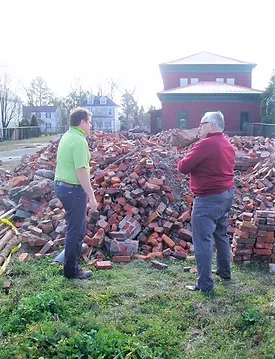
Motsinger singled out John Edwards, general director passenger policy, in the NS strategic planning group for his efforts in making it happen. NS operates the EC line for the North Carolina Railroad, and Edwards is the primary NS planning liaison between the two railroads.
Tim Bentley, regional vice president, state relations, from our government relations team, also got involved. “So often we’re viewed as being divorced from the communities where we operate, and that’s simply not the case,” Edwards said. “We live there, we breathe there, we have employees there. Here we had an opportunity to work with a community we’re a part of and we were able to do so in a way that makes sense for us, for our partner North Carolina Railroad, and for the community we’re in. I think that’s important.”
John Blackwelder, a member of the Preservation Foundation’s board, formerly worked in the brick and masonry products industry and provided a wealth of knowledge about the bricks coming from the demolished building. “The bricks from the shop were probably made locally around the turn of the 20th century”, Blackwelder said. “It appears to be a mix of handmade bricks and manufactured bricks.”
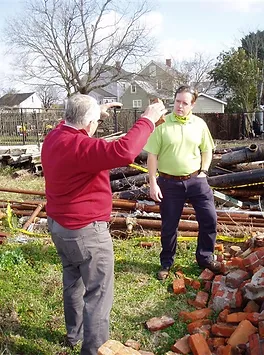
The Preservation Foundation may use some of the bricks to reconstruct a fireplace and chimney in the main waiting room of Union Station Depot, a former passenger rail depot from 1910 to the mid-1950s. Some of the bricks may also be used to restoration work on the King Solomon Lodge structure’s foundation.
As part of fund-raising efforts, the Preservation Foundation expects to sell some the bricks to residents who need them for repairing New Bern’s numerous historic structures. “There’s multiple facets that make this positive,” Motsinger said. “It’s good from the historical significance, it’s good from the community relations aspect, and it’s good from the environmental perspective. This is a true beneficial reuse of these bricks.”